

At 1 a.m., in the dark off Victoria, a humpback whale surfaced beside our kayaks. We'd been paddling for hours. We were cold, wet, hungry and tired. And in that moment, none of it mattered.
This is the story of that paddle, and what 24 hours on the water taught us about our bodies and, even more, our minds.
Why we paddled
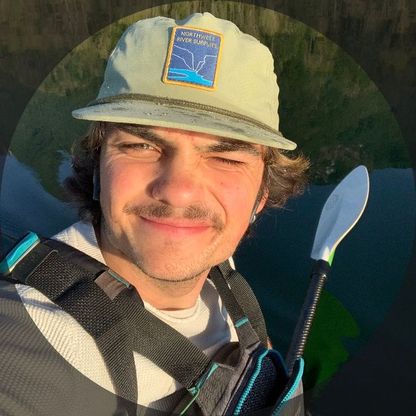
Ethan is one of our Paddle Canada instructors and kids camp leaders at Ocean River Sports in Victoria, BC. He's young, he's everyone's friend, and he brings an infectious, fun energy to everything he does. So when he told me he wanted to paddle for 24 hours to raise money for Movember, my answer was easy. I'm in.
Movember funds men's health: mental health and suicide prevention, prostate cancer and testicular cancer. In Canada, suicide rates are about three times higher for men than for women, and suicide is the second leading cause of death for people aged 15 to 34, according to the Public Health Agency of Canada. Those numbers are why we were out there.

The first hours: the body
We launched into the Inner Harbour with fresh arms and a full crew. Over the next 24 hours, people from our community came and went. At times there were six of us paddling together. At other times it was just two. Everyone who showed up, for an hour or for the whole night, carried a piece of it.
Paddling is a full-body workout. Every stroke works your core, back, shoulders and arms, and because the boat carries your weight, it's easy on your joints. Hour after hour, it's steady cardio that builds strength and endurance without pounding your body.
We felt every bit of it. Cold. Rain. Then sun. We hauled our boats out for a portage, then did it again. Hunger that hit hard in the late hours. But that effort pays off in more than muscle. A 2024 review in The BMJ, pooling 218 randomized trials with over 14,000 participants, found exercise to be an effective treatment for depression, with bigger benefits at higher intensity. The authors say it belongs alongside therapy and medication as a core treatment.

Into the Gorge: the mind
As the day went on, the city fell away. We wound up the Gorge Waterway, one of the most beautiful urban paddles anywhere, and later crossed into Esquimalt Harbour. Seals popped up to check on us. Sea lions barked and rolled nearby. The bird life was incredible.
Out there, your phone stays in the dry bag. Your breathing slows. Your brain finally gets a break. That isn't just a feeling. A systematic review of 35 studies on "blue space" (lakes, rivers and the sea) found the strongest evidence for benefits to mental health and wellbeing. And a study of nearly 20,000 people found that those who spent at least two hours a week in nature had 59% higher odds of reporting good health and 23% higher odds of high wellbeing than those who spent none.
Two hours a week is enough to make a difference. We were going for 24 straight.
1 a.m.: the humpback
Night paddling strips everything back. It was dark, it was cold, and the group had thinned out. Tired doesn't really cover it.
Then we heard it. A humpback, breathing in the dark right alongside our kayaks. I've been paddling for nearly 20 years, and that is a moment I will never forget. In an instant, the cold and the hunger and the sore shoulders didn't matter anymore.
There's a word for that feeling: awe. It makes your problems feel smaller and the world feel bigger. It's the reset so many of us need, and so many men never give themselves.

What we came off the water with
By the time we pulled the boats up, we were wrecked. And we somehow felt better than when we started.
That's what I want people to take from this. Time on the water is good for your body, and it's even better for your mind. Some of the best conversations happen side by side in a boat at 3 a.m. A lot of guys find it hard to say how they're really doing across a table. Out there, it comes easier.
Recognized for it
Ethan's fundraising earned him a Movember award, and Ethan, his family, and I were invited to Vancouver for the Movember party and awards night. Watching one of our own get called up was something special. Supporting our staff in their adventures is one of the most rewarding parts of my job, and Ethan makes it easy.
Next up: 24 hours paddling, 24 hours running
Ethan's going even bigger. His new goal is $10,000. To get there, he'll paddle for 24 hours and run for 24 hours.
Just like last time, he'll need his community. Some hours there will be six people beside him. Some hours it'll be one or two. Every one of those hours counts.
How you can help
- Donate. Every dollar gets him closer to $10k: Support Ethan on Movember
- Join him for a stretch. Paddle an hour, run a few kilometres, or show up with snacks and some noise. Details will be on our socials.
- Share this story with your friends, family and paddling crew.
- Get outside. Give yourself your two hours a week.
- Check in on the guys in your life. That's what Movember is really about.
Let's get him to $10k. Go Ethan!
See you on the water,
Jamie Dawson, Ocean River Sports, Victoria BC
Sources
- White, M.P. et al. (2019). Spending at least 120 minutes a week in nature is associated with good health and wellbeing. Scientific Reports, 9, 7730.
- Gascon, M. et al. (2017). Outdoor blue spaces, human health and well-being: a systematic review of quantitative studies. International Journal of Hygiene and Environmental Health, 220(8), 1207-1221.
- Noetel, M. et al. (2024). Effect of exercise for depression: systematic review and network meta-analysis of randomised controlled trials. The BMJ, 384, e075847.
- Public Health Agency of Canada. Suicide in Canada: Key statistics.